Monday, October 10, 2011

Bird Body Language

No, this Killdeer is not waving hello or doing bird yoga--it is performing a species-saving technique called "the broken wing display". When a perceived predator gets close to a parent's nest or young, it scurries off, leading the predator away from a potential meal. By feigning injury, the parent deceives the predator into thinking it is in fact the easy target, thus saving its young from attack. Sometimes both parents dart away from their booty in different directions, which can truly befuddle a predator (or a photographer).

With a baby this cute, who wouldn't risk his or her own life?

Sunday, July 10, 2011

Food!

This Osprey (#1) on Lake Union careened around its desired mate (#2) for an hour, making pathetic keening noises all the while. As #1 approached #2, which was sitting on the light fixture to the right, #2 flew away. #1 didn't seem to notice the departure and approached the now empty light fixture with more keening and a courtship offering: a decapitated, bloody silver fish.
A more productive and better example of food-offering: an insistent black-capped chickadee fledgling being fed an insect by its parent on Capitol Hill.

And now...viscera! Entrails! Blood, guts, beak and gore. A juvenile Red-tailed Hawk with a just-killed meal. As I biked past a stand of cottonwoods I heard the hysterical alarm calls and protestations of robins, starlings, chickadees and crows. I knew this boded well for me and my camera (but not for the unfortunate victim and family) so I headed toward the ruckus. I'm pretty sure the kill is a robin nestling due to the dark grey feathers, size and length of legs.


And goodbye! The hawk was escorted off the premises by all species, including an Anna's Hummingbird.

Monday, July 4, 2011

Kitchen Table Birding

I didn't have to go further afield than my own kitchen to witness this absurd yet amusing avian trick: the old I'm-so-addicted-to-pistachios-that-I-will-endanger-my-life-to-eat-one gambit.
Stripey looks on smirking.

Poor Lemon was not able to get herself out without my help--but even as she was stuck, she continued to eat nuts.

This is not a stunt that I will encourage. Such is motherhood.

Thursday, June 30, 2011

Happy International Bluebird Day!

Okay, so there isn't really such a day, but there should be because bluebirds make everyone happy.

This mountain bluebird pair along Umptanum Road was nesting in a fence post in a hole about a foot from the ground; on the opposite side of the post about four feet up, a house wren abode was in full swing. All four parents were so intent upon feeding their young that they allowed me to sit with my camera about 10-12' away for a good half-hour.

 To the left is a male western bluebird, distinguished by ruddy coloration on its scapulars, bringing prime insect dinner to its young. Below is the inside of one of the scores of nestboxes built by the Yakima Audubon Society along the Umptanum Road to the west of Yakima. 
 If you aren't smiling by now, please seek medical advice immediately.


Friday, June 24, 2011

Nature's hieroglyphics

 
Not sure exactly who's handiwork/beakwork/mouthwork this is, but certainly looks like hieroglyphics on a totem pole. I think the hole is courtesy of a tree swallow, or perhaps a smallish woodpecker. The curvy lines, I assume, are the trails of some sort of insect boring its way through the wood, gaining sustenance along the way.

Seen along the Yakima River at Elk Meadows Park.

Sunday, June 5, 2011

Warning: Cuteness Overload

If you don't like avian cuteness, this is not the blog--or the season--for you. Today's cuteness is courtesy of a local Killdeer family which resides in the gravel parking lot at the Montlake Fill (AKA the Urban Horticulture Center or the Union Bay Wildlife Area).

Sunday, May 29, 2011

Killer Crow


Preface: These shots are crappy and not up to BirdWordGirl standard; but they illustrate something not often seen, so it is worth sharing them, despite the damage they might wreak upon my PhotoEgo.

Yesterday morning at low tide along the Duwamish River. Lots of juvenile starlings around; this one got very unlucky. For two agonizing minutes, the crow plucked and pecked at the starling, who squealed and cried on its back, pedaling its legs in protest. Meanwhile all nearby starlings and robins went beserk with alarm calls.

The crow spent nearly as much energy defending its killing process from its voracious corvid colleagues as it did pecking at the starling.


Frankly, it was a relief when the body was finally lifeless and feathers began flying as the crow tucked in. After a few seconds, the crow flew off with the body, assailed by its colleagues.


(Yes, I did briefly consider stopping the killing but the hard facts intervened: starlings are a non-native species which are numerous and at times quite harmful to native species.  If it had been a Flicker, my favorite bird, I would have gone ballistic on that crow's ass.)

Wednesday, May 25, 2011

Sunbathing is for the birds

We had feeble, fleeting moments of sun on Sunday and this Flicker took advantage of the warmth to stretch, yawn and take a sun bath. She extended her wings, lowered her body to the sun-warmed branch, closed her eyes and lolled her head to the side. Kind of like us.


Tuesday, May 17, 2011

Owl prowl: success!

Thanks to the expert ear and owl calls of Luis, my birding guide in San Pancho, we found this adorable bundle with delicately arched eyebrows, AKA a  Ferruginous Pygmy Owl.

Ferruginous: from Latin: ferrgin-, iron rust, iron-rust color.

Pygmy: it's damn small--with a body about the size of a man's balled fist.

Seeing this owl and capturing its face was particularly satisfying as I'd briefly seen its relative, the Northern Pygmy Owl, in Arizona last fall. It was similarly perched above me, about 20' up, in an anonymous, indistinct little brown ball which flew away before I could photograph it well. So being able to look into the face of a Ferruginous Pygmy Owl makes me feel the circle is somewhat closed now.

Green-winged bombers

 
Who wouldn't want to be dive-bombed by orange-fronted parrots in the Mexican jungle?

Sunday, May 8, 2011

Extreme Cuteness in the Hood

Golf balls with wings--that's what I call bushtits. They are round-bodied, petite birds with an unfortunate name (almost an erotic oxymoron, no?) and the most endearing manner. Flitting around neighborhoods en masse, gleaning tiny insects from trees and shrubs, they are remarkably unfazed by humans and are often happy to go about their business within a few feet of people.

This one, shot yesterday during a spontaneous evening walk, landed in my friend Paul's front yard on East 20th Street and wins bonus Cuteness Points for being fluffy and disheveled from a recent bath or collision with some very wet shrubbery.

An very occasional visitor to the hood is a yellow-rumped warbler. Probably a spring migrant, passing through, which  are more often seen in the Arboretum and the Fill. The spring weather has been so winter-ish, that it's hard to believe that brightly colored warblers and tanagers are passing through the city, spangling our tress and flowers with tropical oranges, reds and yellows.

That said, this house finch (right) is very much a residential bird in the hood through the year. His breast en-reddens (new word!) for the ladies in spring.  Male house finches can exhibit an interesting range of color variation--from red to yellow to gold--which is determined primarily by diet.  More and more research shows that in general, female birds are attracted to vividness of color more than size in male birds. Hmmmm.

Saturday, May 7, 2011

Flickers Flicking


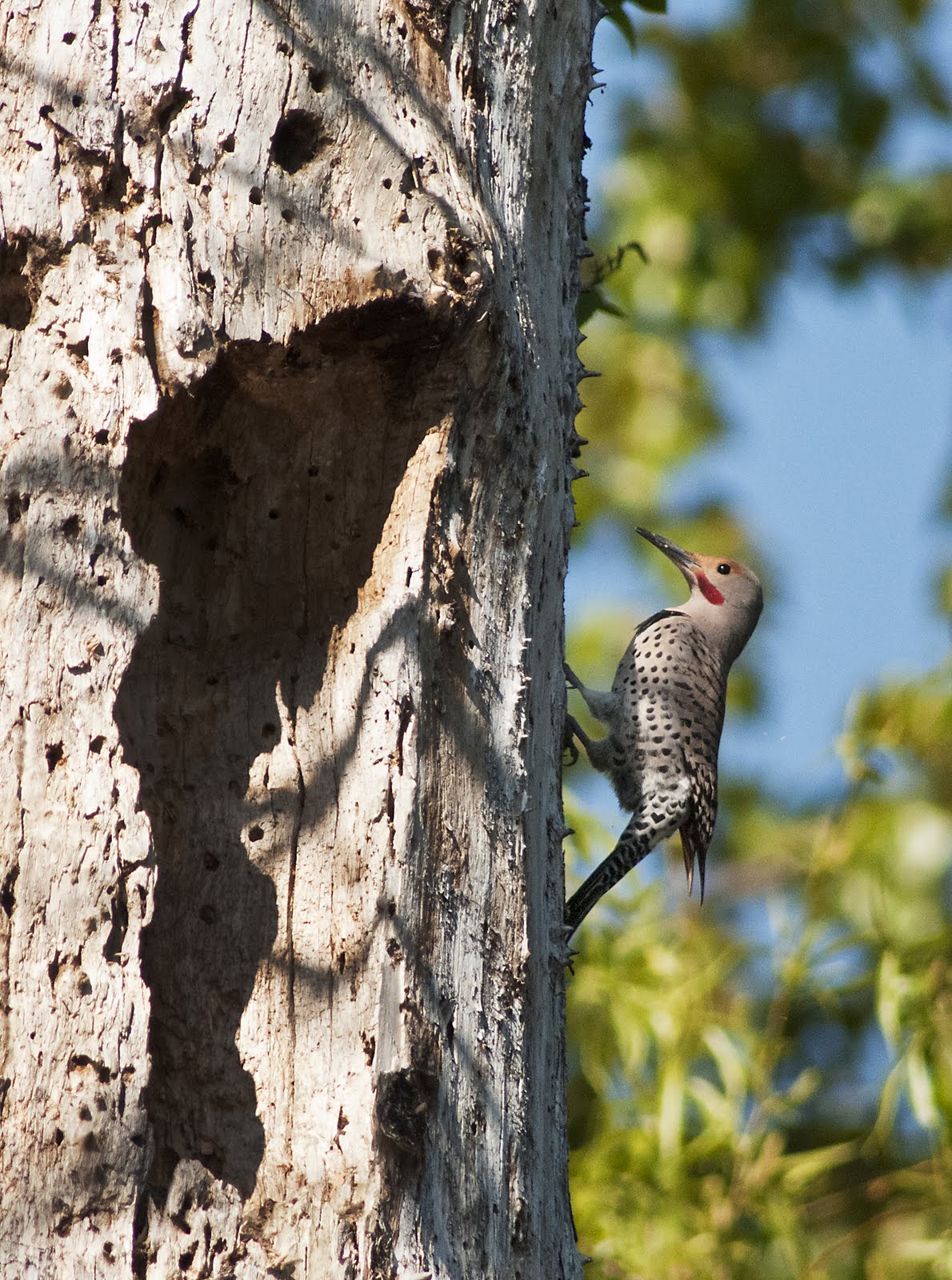
In Spanish, woodpeckers are known as carpinteros--carpenters. Of course, we talk of woodpeckers "hammering" or "drilling" on a tree, but they are also hearty makers of sawdust, as illustrated here. After being upside down (below) in its cavity for a few minutes excavating a deeper and deeper cavity for its nest, this flicker turns right side up with a beakful of debris which it then flings to its left. Without fail, both male and female at this Lake Union nest perfom their nestbuilding exactly this way, hour after hour--always throwing dust to the left.

Friday, May 6, 2011

Woodpecker Wonderland

Biking along the Burke-Gilman Trail on Sunday was like zooming through a tunnel of Northern Flicker Love Songs. There was an unending necklace of wicka-wicka-wicka mating calls reverberating in the trees.

As I slowed down my bike to get my camera out, I was literally eye to eye with a Pileated Woodpecker (at left) in a tree.  These stout birds are remarkably skittish for the size, but this one was insanely indifferent to me and my camera. At one point, I was probably five feet away from her as she pounded a tree for insects. Her thread-like tongue is visible in this shot, emerging from the tip of her beak like a serpent's hiss.

Of course, I'm no ornithologist, but my guess is that during the mating and nesting season birds are so zealously finding nesting material and food to fuel their parenthood that they become somewhat oblivious to what would normally be a threat (a sweaty, dorky bike helmet-wearing human with a long camera lens).

This male Northern Flicker (at right) was excitedly excavating a nesting hole alongside Lake Union.  Occasionally he would stop his pounding and make a mating call, which went unaswered.
A bit further away on the lake, I discovered a mated pair taking turns excavating their nest. About every 20 minutes one approached the nest, vocalizing to announce his or her incoming arrival to its mate who was working away in the hole. The vocalization helped me too--so that I could ready my lens to capture shots like this one below.


Tuesday, April 12, 2011

Going Courting


Seattle has had a very inclement spring thus far, but the birds persevere with their courting. This male Northern flicker (left) and Brewer's Blackbird did what they could to attract the ladies on a cloudy, winter-y spring day at the Montlake Fill.

A few hours earlier on campus, this heron made the bird with two backs after proffering a well chosen stick for his consort back at the nest.

Sunday, April 3, 2011

It Takes a Village...

to make a heronry. Ma and Pa Heron passing a stick to each other.

Very encouraging news from the UW heron colony: the number of nests on the western side has at least doubled over last year! Five nests alone are in one tree slightly to the northwest of the main core of last year's group. Plus, one or two--can't tell--more in conifers across the walkway slightly to the east. And there are about two or three more nests in the grouping next to the EE/Paul Allen building.

The skeletal beginnings of a new nest, well-silhouetted by the setting sun.


On the hunt for the perfect twig, this bird extends its left wing to keep its balance.

Sunday, March 20, 2011

Say YES to Spring

                                         This yellow-rumped warbler agrees.

Saturday, January 15, 2011

Cormorants à la mode d'Audubon


Bickering, snickering, sniping and biting, jostling and jousting: this erupts when dozens of double-crested cormorants settle in for the night's roost in a row of tall trees along the the Ship Canal.

John James Audubon. Rough-Legged Falcon, 1938. 
Arriving from a day of fishing in the Sound or a nearby lake, their approach and landing are awkward and ungainly; they often have to circle around two or three times to make successful purchase on a branch. Landing is even more problematic if it aims to settle in next to another bird who is already comfortably tucked in--squabbling and scuffling ensue. But only briefly--the argument is short-lived, practically perfunctory, and quickly everyone calms and quietens.


This jostling and jousting and the postures of aggression remind me of Audubon's depiction of birds: he often painted them in a pugilistic contortions: necks twisted, beaks open, bodies torqued in battle. I'm not sure if he did this intentionally, to show off the expanse of wings, the full glory of coloration, or if it reveals something about his perception, conscious or not, of the nature of human relations.

As a photographer, I am amazed by his ability to freeze moments of such action and flurry without having had the benefit of stopping time with a camera. How was he able to envision and execute split-second postures and actions in such a masterly way?