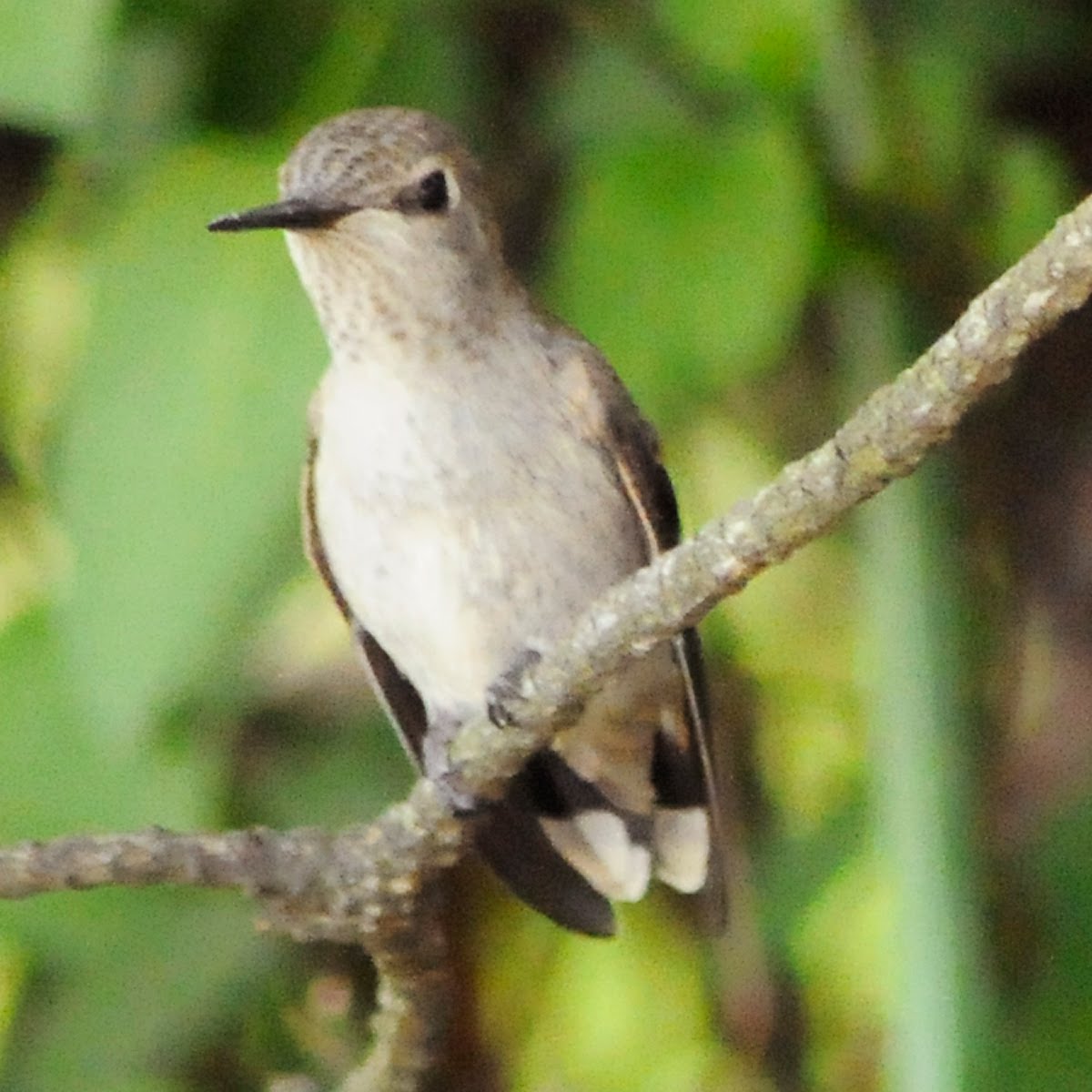
Looks are deceiving: this lovely emerald and bronze creature zooms and zaps anything it perceives to be an intruder. That could be another hummingbird, you, me, a crow, a robin or anything else.
Monday, June 28, 2010
Sunday, June 27, 2010
Better Baby Picture
A nestling in the western heronry on campus today. It's got its sights on me, already exercising the keen vision which will serve it well once it fledges and has to fish for breakfast, lunch and dinner on its own.
Sunday, June 20, 2010
Hello, Heronettes!
At first, I didn't think anybody was home when I visited the heronry on campus Friday evening. A sudden SPLAT!! to my right, and a bit on my cheek, soon told me otherwise. Baby heron butt above.
Hard to be sure, but I estimate at least five or six nestlings in the eastern heronry. And some of them have nearly lost all their fuzz, so perhaps they are about three-to-four weeks old.
In fact, some of them were stretching and flexing, at the very edge of their nests; I sensed their boredom, their itch to move--just like plane travellers on a cross-country flight.
You can see the keratin sheaths from which their primary feathers emerge--they look like slender grey tubes. On smaller birds, like my cockatiels or songbirds, they are called pin feathers because they really do look like needles or pins when they first emerge, the feather completely encased in the sheath liked a tightly rolled umbrella.
When a bird runs its beak through its feathers, the behavior called preening, it is sometimes helping the sheath dislodge and fall away. Social birds, like parrots, sometimes do this for each other. And I sometimes help my cockatiel Lemon remove her sheaths with my fingers. You can see the result on my floors.
Hard to be sure, but I estimate at least five or six nestlings in the eastern heronry. And some of them have nearly lost all their fuzz, so perhaps they are about three-to-four weeks old.
In fact, some of them were stretching and flexing, at the very edge of their nests; I sensed their boredom, their itch to move--just like plane travellers on a cross-country flight.
You can see the keratin sheaths from which their primary feathers emerge--they look like slender grey tubes. On smaller birds, like my cockatiels or songbirds, they are called pin feathers because they really do look like needles or pins when they first emerge, the feather completely encased in the sheath liked a tightly rolled umbrella.
When a bird runs its beak through its feathers, the behavior called preening, it is sometimes helping the sheath dislodge and fall away. Social birds, like parrots, sometimes do this for each other. And I sometimes help my cockatiel Lemon remove her sheaths with my fingers. You can see the result on my floors.
Saturday, June 19, 2010
Secret Sap
What could these two possibly have in common?
This:
They were both addicted to whatever elixir this tree produces. I first noticed the squirrel licking the tree, then saw flies on it and then the sapsucker showed up, who had made the pattern of gouges over time.
And I really do mean addicted: the woodpecker's desire for sap overrode its life-protecting impulse to flee upon seeing me. Initially, when I was about 30 feet away, it was spooked by my presence. After gradually creeping closer over an hour, I was about six feet away from it. The bird was so enthralled by the tree's excretions that it didn't mind me or my camera shutter clicking.
This:
They were both addicted to whatever elixir this tree produces. I first noticed the squirrel licking the tree, then saw flies on it and then the sapsucker showed up, who had made the pattern of gouges over time.
And I really do mean addicted: the woodpecker's desire for sap overrode its life-protecting impulse to flee upon seeing me. Initially, when I was about 30 feet away, it was spooked by my presence. After gradually creeping closer over an hour, I was about six feet away from it. The bird was so enthralled by the tree's excretions that it didn't mind me or my camera shutter clicking.
Table Manners
Steller's jays are usually even more rabidly territorial and cranky and loudmouthed than their fellow corvids, crows. In other words, if you breathe in their direction from 20 yards away, you will be raucously upbraided by a brilliantly blue bird as if you'd pulled out its nails without anesthesia. (Postscript 6/20: After watching the Italy v. New Zealand World Cup game this morning, I realize it's apt to liken the histrionics of jays to that of Italian footballers when they have been "injured" on the field.)
This morning I met a welcome and unusual exception to this rule--even more unusual because it was a juvenile accompanied by a parent, an occassian when outsized squawking has some merit. The parent was either on avian qualudes or got some sort of cease-and-desist order on the squawking. Here's the cute juvie solo with a little green insect ensnared in its toes and then begging for food:
Notice the small light-colored spot where the beak joins the head (right), a telltale sign of a young bird. This slightly yellow or pink fleshy bit allows the bird to open its beak really wide for food, and reveals a startling reddish-pink mouth (see below).
Also typical of begging behavior is the outstretched wings, which are shaken and/or lifted up and down very quickly as if the bird were trying to propel itself into the air. It's rather telling that the drive for food and sex ellicits similar postures. Below is a juvenile crow in the same begging posture with its parent.
This morning I met a welcome and unusual exception to this rule--even more unusual because it was a juvenile accompanied by a parent, an occassian when outsized squawking has some merit. The parent was either on avian qualudes or got some sort of cease-and-desist order on the squawking. Here's the cute juvie solo with a little green insect ensnared in its toes and then begging for food:
Notice the small light-colored spot where the beak joins the head (right), a telltale sign of a young bird. This slightly yellow or pink fleshy bit allows the bird to open its beak really wide for food, and reveals a startling reddish-pink mouth (see below).
Also typical of begging behavior is the outstretched wings, which are shaken and/or lifted up and down very quickly as if the bird were trying to propel itself into the air. It's rather telling that the drive for food and sex ellicits similar postures. Below is a juvenile crow in the same begging posture with its parent.
Sunday, June 13, 2010
Baby Stuff
Yes, it's that time of year. Cute fledglings and parenting activity abound.
I accidentally flushed this young savannah sparrow from a field and, not yet able to fly, it skittered away like a cartoon character, its wings windmilling across the pavement. A parent soon followed it. At the Kent Ponds.
Fledgling junco with dad in the Arboretum yesterday afternoon.
Chestnut-backed chickadee at a nesting box in the Arborteum.
Mom mallard with hygenic offspring.
I accidentally flushed this young savannah sparrow from a field and, not yet able to fly, it skittered away like a cartoon character, its wings windmilling across the pavement. A parent soon followed it. At the Kent Ponds.
Fledgling junco with dad in the Arboretum yesterday afternoon.
Chestnut-backed chickadee at a nesting box in the Arborteum.
Mom mallard with hygenic offspring.
Pugilists' Sunday II
Pugilists' Sunday
The cedar waxwings at the Kent Ponds today were out in full force, both in numbers and in attitude. Lots of jockeying for position--as many as four to six crammed on a branch, one inevitably bickering at and jostling the others.
In fact, I had a brief, much-coveted sighting of a male lazuli bunting, but it too was displaced by a waxwing who apparently had nothing better to do than muscle his or her way onto the branch, although there were literally acres of unpopulated branches available. Anthropomorphizing aside, this is presumably keyed-up territorialism due to mating season.
Friday, June 11, 2010
Finally!
Enfin! A non-blurry image of a brown creeper. Like the towhee 20 yards away from it, this creeper in the Arboretum this afternoon was unusually unfazed by my presence and did its nimble peregrinations in front of me rather than scurrying away. Thank you, brown creeper.
Eponymous
Song sparrow doing its song thing. It was singing back and forth with a spotted towhee, who was proclaiming himself for about half and hour from a bare branch, which is not their MO, in my observation. Towhees are generally pretty secretive and furtive, scratching around on the ground, hanging out in shrub-height greenery. But this one was going for it--you can even see the pink of its mouth:
Sunday, June 6, 2010
Seeing Red
Please meet my new best friend, the cinnabar moth. It is improbably beautiful and striking, straight from central casting for enchanting winged creatures. I discovered it while birding in a field next to the Black River in Renton yesterday afternoon.
The intensity of the red and the black, the graphic interplay of the dots and swirls, remind me of Preston Singletary's glasswork (below, top, is Raven Steals the Stars). Another striking red-black combo is this hybrid red-naped x red-breasted sapsucker sucking sap in Hylebos Wetlands Park in Federal Way yesterday.
Sunday, May 30, 2010
The Audacity of Coloration
Ruby and crimson and emerald and shimmery--this Anna's hummingbird is in his full glory, unlike the tabula rasa juvie seen at the bus stop (in previous post).
And bossy and territorial and ballsy. He was divebombing a courting cedar waxwing just before I took this shot. The courtship was really sweet: both birds were offering berries to each other.
Saturday, May 15, 2010
Bus Stop Birding
Pure serendipity: waiting for the bus this morning and was accompanied by this Anna's hummingbird. I'm pretty sure it's a juvenile as it lacks much coloration on its head and throat. Plus, the wings extend beyond the tail; in an adult, the tail feathers extend beyond the wing tips.
And it had a pure, naive affect--too young and inexperienced to realize that I was a potential threat. Instead of zipping away upon seeing me, it placidly checked me out.
Wednesday, May 12, 2010
The Babies Are Coming, the Babies Are Coming!
The bushtit nest a few blocks away is suddenly wiggling with life--mother and father are on ceaseless food procurement duty now that their babies have hatched.
Here is dad with a creepy-crawly high-protein meal.
Below is dad, left, and mom, right, as they emerge from nest after feeding young.
Parking Lot Birding
Sometimes the best birding happens before the birdwatching officially begins. On Saturday morning I was waiting with a bunch of Auduboners in a parking lot before setting off for a field trip to Fort Lewis, when I noticed this very, very waterlogged bird.
It was taking advantage of the dewy grass and taking a bath--burrowing and burrying its head into the damp blades and shaking back and forth with great enthusiasm.
It wasn't the "best" birding of the day, but it was definitely the most charming.
It was taking advantage of the dewy grass and taking a bath--burrowing and burrying its head into the damp blades and shaking back and forth with great enthusiasm.
It wasn't the "best" birding of the day, but it was definitely the most charming.
Sunday, May 2, 2010
The Path to Yum
"You guys are so mean!" Uncensored and admonishing, these were the first words out of my mouth yesterday. (Yes, I talk involuntarily out loud to birds.)
I was talking to the two crows who lucked upon a juvenile robin for breakfast yesterday. As I approached, one flew off with its head. The body was freshly dead, still warm and pliable.
While I photographed the body, one crow stood sentry above, waiting to claim the corpse.
Many conflicting thoughts: Those damn opportunist crows. But crows need to eat. I love crows. The cycle of life. The poor bereft robin parents. Robins are plentiful and skilled procreators, at least thus far into the century. Survival is a numbers game; that's why birds lay so many eggs, sometimes more than once per breeding season. I, too, am an opportunist. I am taking advantage of the bird's death by transforming it into a blog entry. Opportunism has a perjorative implication, but in the ecological sense, it can be used in a neutral sense too, I think.
Here is a more amusing, and less successful, Attempt At Yum I saw a few hours later in Marymoor Park in Redmond:
Clearly, this male mallard had found his own Path To Yum, as evidenced by his grassy beak.
Wednesday, April 28, 2010
Avian Acrobatics
Upside down is easy for this avian acrobat. Bushtits are diminutive, agile and nimble; they scramble, dangle and wrangle in search of food and nesting material.
They often travel in packs and are sometimes so consumed with their gleaning activities that they are indifferent or oblivious to nearby humans. This male (see the yellow eye) was no more than 18 inches from me in a chest-high bush while I took many shots.
Earlier in the day, he snagged a great blue heron feather which had fallen from the nesting colony above his own nest.
This bushtit and his mate have fortuitously chosen their nest location--there will continue to be a supply of heron feathers falling from above throughout the summer.
They often travel in packs and are sometimes so consumed with their gleaning activities that they are indifferent or oblivious to nearby humans. This male (see the yellow eye) was no more than 18 inches from me in a chest-high bush while I took many shots.
Earlier in the day, he snagged a great blue heron feather which had fallen from the nesting colony above his own nest.
This bushtit and his mate have fortuitously chosen their nest location--there will continue to be a supply of heron feathers falling from above throughout the summer.
Tuesday, April 27, 2010
Happy Heron News
On Friday I went to check on the herons and was thrilled to discover that the mini colony next to the Paul Allen building now hosts six nests--four more than I saw two weeks ago. These herons are obviously the cool kids on the block, breaking into a new real estate market.
As the nests are newer, they were much more actively hunting for material than those old school herons 100 yards to the west.
This nest is definitely newer as it appears less dense from the ground. The two birds are squeezed in side by side, almost spilling out beyond the nascent structure's perimeter.
Sunday, April 25, 2010
Nest Serendipity
At 9 am two Sundays back, I Googled "brown creeper nest" because I wanted to see what kind of domicile these peripatetic feathered creatures construct. According to my field guide, they build "behind a loose slab of bark still attached to a living or dead tree...sides of nest continue upward, ending in points (crescent-shaped like hammock, half-moon)."
Hmmm, this sounds convoluted. And complicated, I thought. There's no way in hell I'll ever find one of those.
But by 10 am, I was standing in front of not one, but two creeper nests! Like the brown- and cream-marbled bird, the nest is well camouflaged. They take advantage of cracks in branches or bark peeling away from the trunk. They then stuff if with the usual small bird favorites: moss, hair, feathers.
On the left is the nest, only about three feet from the ground, on April 11. On the right is the same nest, with additional material, on April 22. No eggs yet.
Here is the host tree, on the UW campus. Another nest is in a crevice in a branch to the right.
Here is the architect at the entrance of the branch nest:
The serendipity continued...the heron colony was about 30 feet up the path. And beneath that was a very plump bushtit nest, scenically dangling above a blazingly crimson rhododendron.
Hmmm, this sounds convoluted. And complicated, I thought. There's no way in hell I'll ever find one of those.
But by 10 am, I was standing in front of not one, but two creeper nests! Like the brown- and cream-marbled bird, the nest is well camouflaged. They take advantage of cracks in branches or bark peeling away from the trunk. They then stuff if with the usual small bird favorites: moss, hair, feathers.
On the left is the nest, only about three feet from the ground, on April 11. On the right is the same nest, with additional material, on April 22. No eggs yet.
Here is the host tree, on the UW campus. Another nest is in a crevice in a branch to the right.
Here is the architect at the entrance of the branch nest:
The serendipity continued...the heron colony was about 30 feet up the path. And beneath that was a very plump bushtit nest, scenically dangling above a blazingly crimson rhododendron.
Tuesday, April 13, 2010
Croak Loudly and Carry a Big Stick
Watching a Great Blue Heron hunt for sticks and branches for his nest is, for birders, like watching the Wide World of Avian Sports: a show filled with the thrill of victory and the agony of defeat.
Herons are about as tall as a second grader and have a wing span of six feet. They employ acrobatics, yoga, and hormone-propelled ambition to snap branches off, which are then shuttled back to the nest for precision placement.
When approaching a potential branch, he crouches in a hunting posture as he does when hunting for food in water.
With his target in sight, he coils his neck back
and darts forward, serpent-like, to claim the branch with his indomitable beak.
Then the majestic struggle begins. He spreads his wings out to counterbalance the extension of his neck.
Then he begins to navigate back through the tree canopy, unwieldy branch in beak. This is where the agony of defeat can occur: when his path becomes too treacherous or obstructed, he will resort to a cumbersome, clumsy flight--sometimes crashing through branches--to the nest. All that to get one stick to its nest. That's a lot of hormones.
To see more photos: http://www.flickr.com/photos/claremclean/?saved=1
(This bird is one of a handful of pairs that has been building a mini-colony on the UW campus, south of Drumheller fountain. This is the third year I've seen them there. I counted four nests in one stand of trees and two in another; I can't verify if all nests are active.)
Herons are about as tall as a second grader and have a wing span of six feet. They employ acrobatics, yoga, and hormone-propelled ambition to snap branches off, which are then shuttled back to the nest for precision placement.
When approaching a potential branch, he crouches in a hunting posture as he does when hunting for food in water.
With his target in sight, he coils his neck back
and darts forward, serpent-like, to claim the branch with his indomitable beak.
Then the majestic struggle begins. He spreads his wings out to counterbalance the extension of his neck.
Then he begins to navigate back through the tree canopy, unwieldy branch in beak. This is where the agony of defeat can occur: when his path becomes too treacherous or obstructed, he will resort to a cumbersome, clumsy flight--sometimes crashing through branches--to the nest. All that to get one stick to its nest. That's a lot of hormones.
To see more photos: http://www.flickr.com/photos/claremclean/?saved=1
(This bird is one of a handful of pairs that has been building a mini-colony on the UW campus, south of Drumheller fountain. This is the third year I've seen them there. I counted four nests in one stand of trees and two in another; I can't verify if all nests are active.)
Subscribe to:
Posts (Atom)